[ Factory Agent ]

AI that works on your PLC code. Engineers who decide.

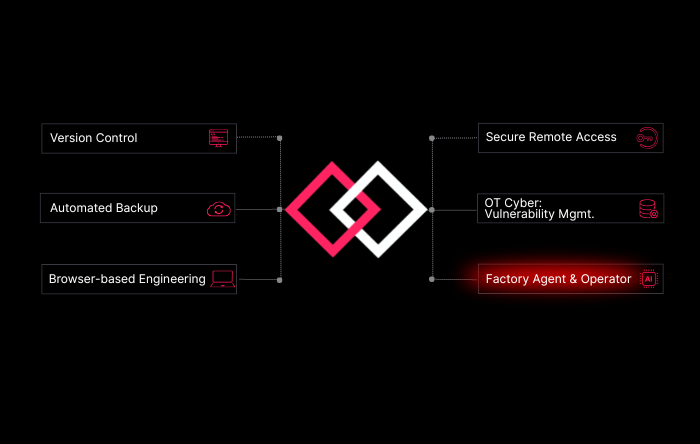
Factory Agent reads, explains and drafts control logic across vendors – on top of one system of record for what every controller should run and what it actually did. The agent proposes. The engineer approves.
  • 0%
    Reduction in code understanding time
  • 0x
    Faster engineer onboarding
  • 0%
    Reduction in consultant costs
[ Why it works ]

An agent is only as good as the ground it stands on.

Most AI for automation starts with a chat window. Factory Agent starts with the factory's state. It works on the source code SDA extracts from vendor projects and normalizes into one record – the intended state of every controller – and on what those controllers actually ran.
That is the difference between an assistant that guesses and one that knows. An agent cannot explain logic it cannot read. It cannot propose a safe change on a controller it cannot address. And it cannot be trusted with a plant whose actual state nobody can see.
  • Reads the code

    Normalized source across vendor ecosystems – not screenshots, not exports, the real program.

    Reads the code

  • Knows the target

    Every version, every change, who made it and why – the intended state as a living history.

    Knows the target

  • Sees the drift

    Where a controller runs something other than its target program, the agent sees it too.

    Sees the drift

[ How it works ]

The agent proposes. The engineer approves.

  • Propose

    The agent explains logic, documents a block or drafts code from a functional description.
  • Review

    The engineer sees exactly what would change, side by side, with the agent's explanation.
  • Approve

    Only an engineer releases the change. Nothing reaches a controller without that step.
  • Trace

    Every proposal and decision is versioned and auditable – and can be rolled back.
[ Capabilities ]

What Factory Agent does today

Many factories still rely on decades‑old PLC code that few engineers fully understand. When updates or fixes are needed, teams face costly reverse‑engineering and outdated documentation.

Software Defined Automation’s AI Factory Agent changes that. It uses AI to automatically interpret and explain control logic in plain language—turning legacy code into clear, actionable insights. Engineers can troubleshoot faster, onboard easily, and modernize systems with confidence.
  • AI Code explanation & documentation

    AI Code explanation & documentation

    Turns decades-old control logic into plain language and documents new code automatically – so the night shift understands what the machine was told to do.

  • The AI ST Code Generation

    The AI ST Code Generation

    Drafts IEC 61131-3 Structured Text from a natural-language description or functional spec, with declarations, function blocks and comments – as a proposal for the engineer to review.

  • The AI Difference Explanation

    The AI Difference Explanation

    Explains what changed between two project versions, why it matters and how it may affect behavior – across program blocks, hardware configuration and tag tables.

  • AI Operators to automate tasks on the platform

    AI Operators to automate tasks on the platform

    AI Operators in the SDA Factory Agent automate platform tasks like code analysis, change detection, and documentation generation across multi-vendor PLCs, translating complex Structured Text or Ladder Logic into plain language for faster troubleshooting, onboarding, and informed updates—without vendor lock-in or manual effort.

    Agents that run recurring platform tasks – code analysis, change detection, documentation – across your fleet.

[ ROI impact ]

Deploy smarter. Protect your business.

  • Error-free production

    Prevent production errors before deployment
  • Compliance without compromise

    Meet regulatory compliance requirements
  • Total accountability & audit protection

    Complete liability protection with audit trails
[ Bring your own agent ]

Open by design

Factory Agent is our first agent on the State Layer, not the only one that can run there. Stable APIs, agent-ready interfaces and no data lock-in mean your teams and partners can build their own agents on the same record of intended and actual state. A layer wins by being built upon.